
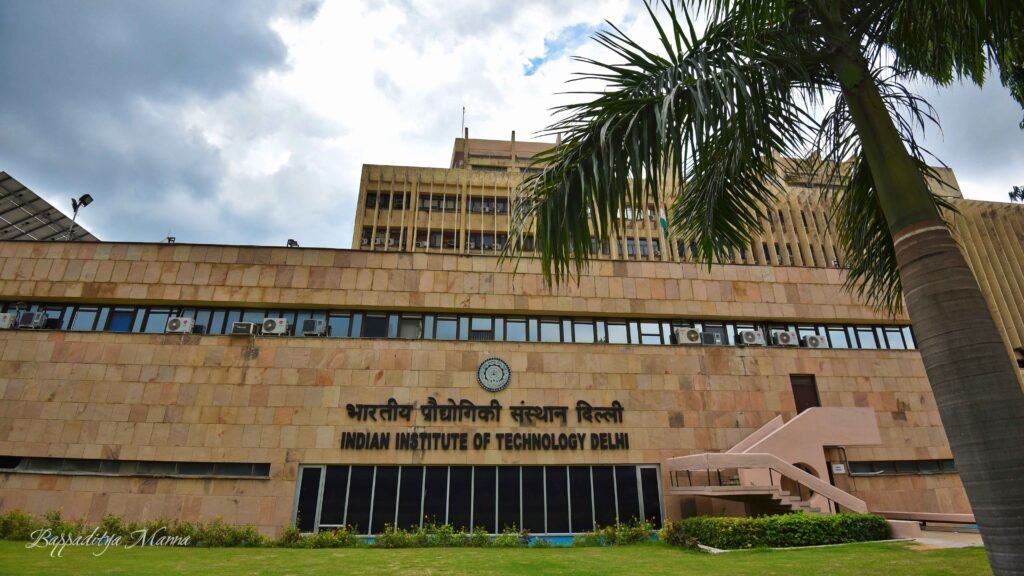
About IIT DELHI
The Indian Institute of Technology Delhi (IIT Delhi) is a public technical institution that was founded in 1961. Situated in New Delhi, the institute is recognised by the University Grants Commission (UGC) and approved by the All India Council for Technical Education (AICTE). IIT Delhi also holds accreditation from NAAC and NBA. According to the NIRF 2025 rankings, the institute secured the 4th position in the Overall category.
IIT Delhi offers a total of 13 undergraduate and postgraduate programmes. At the undergraduate level, it provides courses such as BTech and BDes, while postgraduate programmes include MBA, MSc, MTech, and others. These programmes are available across multiple specialisations. Admissions are granted based on merit and performance in relevant entrance examinations. For example, BTech admissions require JEE Advanced, BDes requires UCEED, MSc admissions are through IIT JAM, MDes through CEED, MBA through CAT/MAT/CMAT, and MTech through GATE.
The institute has a dedicated training and placement cell to support students’ career development. Based on previous placement records, the highest salary package offered reached ₹40.5 LPA, while the average package stood at ₹23.4 LPA. IIT Delhi’s campus is well-equipped with modern infrastructure and facilities, including separate hostels for boys and girls, an auditorium, smart classrooms, a library, laboratories, a gym, and other amenities that contribute to the overall growth of students.
Latest Updates
- CEED 2026 Part A cutoff is out for M.Des admissions. The cutoff has been released in the form of mean (39.35) and standard deviation (16.89). Candidates can check the cutoff details on the official website at ceed.iitb.ac.in. The CEED 2026 result will be declared on March 4, 2026.
- UCEED 2026 Part A cutoff is out for B.Des admissions. The cutoff has been released in the form of mean (70.86) and standard deviation (25.77). Candidates can check the cutoff details on the official website at uceed.iitb.ac.in. The UCEED 2026 result will be declared on March 6, 2026.
- The UCEED 2026 Part A final answer key has been released by IIT Bombay for admission to the B.Des programmes. Candidates can download the official answer key PDF from the UCEED website at uceed.iitb.ac.in. The Part A cutoff marks will be announced on February 5, 2026, and the UCEED 2026 results are scheduled to be declared on March 6, 2026.
- IIT Bombay has released the CEED 2026 Part A final answer key for admission to the M.Des programme. Candidates can access and download it from the official website, ceed.iitb.ac.in. The Part A cutoff will be announced on February 5, 2026, while the CEED 2026 results are scheduled to be declared on March 4, 2026.
- CEED 2026 Draft Answer Key for Part A has been issued by IIT Bombay on the official website, ceed.iitb.ac.in. Candidates can download the question paper and draft answer key and submit objections via the candidate portal by January 22, 2026.
Indian Institute of Technology Delhi (IIT Delhi) is a public institution located in New Delhi. Established in 1961, the institute is recognised by the University Grants Commission (UGC). Some of the key highlights of IIT Delhi for 2025 are given below:
Institute Name: Indian Institute of Technology, Delhi (IIT Delhi)
Year of Establishment | Type: 1961 | Public
Recognised By: University Grants Commission (UGC)
Approved By: All India Council for Technical Education (AICTE)
Accreditation: NAAC and NBA
Rankings:
Ranked 2nd in the Engineering category and 4th overall by NIRF 2024
Placed 150th worldwide in the QS World University Rankings 2025
Popular Programmes: BTech, BDes, MBA, MSc, MTech, among others
Average Fee Range: ₹20,000 to ₹8,10,000
Admission Process: Based on merit and performance in entrance examinations
Accepted Entrance Exams:
JEE Advanced for BTech, UCEED for BDes, IIT JAM for MSc, CEED for MDes, CAT/MAT/CMAT for MBA, GATE for MTech, etc.
Official Website: iitd.ac.in
Courses Offered by IIT Delhi
IIT Delhi offers a total of 13 academic programmes across undergraduate, postgraduate, doctoral, diploma, and certificate levels.
B.Tech
The Bachelor of Technology programme has an annual fee ranging from ₹2,00,000 to ₹8,00,000. Admissions are based on JEE Main and JEE Advanced scores. IIT Delhi offers 17 B.Tech specialisations, including Engineering Physics, Design, Engineering and Computational Mechanics, Civil Engineering, Mechanical Engineering, and several others.
MBA
The Master of Business Administration programme has a yearly fee of ₹2,00,000. IIT Delhi offers three MBA specialisations: Management Systems, Technology Management, and Telecommunication Systems Management.
B.Des
The Bachelor of Design programme is offered in one specialisation and admissions are through the UCEED entrance examination.
MSc
The Master of Science programme has annual fees ranging from ₹20,000 to ₹4,00,000. Admission is granted through IIT JAM or GATE. IIT Delhi offers seven MSc specialisations, such as Chemistry, Physics, Mathematics, Economics, and research-based programmes.
M.Tech
The Master of Technology programme has fees between ₹50,000 and ₹4,00,000 per year. Admission is based on GATE scores. IIT Delhi provides 42 M.Tech specialisations, including Cyber Security, Construction Technology and Management, Design Engineering, Computer Science and Engineering, and many more.
PG Diploma (PGD)
Postgraduate Diploma programmes are offered with an annual fee of ₹3,00,000. There are three PGD courses, including Metro Rail Transport, Naval Construction, and Visionary Leadership in Manufacturing.
Certificate Courses
IIT Delhi offers nine certificate programmes with total fees ranging from ₹55,000 to ₹1,75,000. These include online courses in Digital Marketing, Design Thinking, Data Science, Machine Learning, Project Management, and related areas.
PhD
Doctoral programmes are available in 24 disciplines, such as Chemistry, Physics, Electronics, Telecommunication Technology, and Management Studies.
MS
The Master of Science (Research) programme has annual fees between ₹50,000 and ₹4,00,000. Admissions are primarily through GATE, with 13 research specialisations including Civil, Mechanical, Computer Science, Electrical Engineering, and others.
M.E
The Master of Engineering programme is offered in Biomedical Engineering, with a yearly fee of ₹4,00,000. Admission is through GATE.
M.Des
The Master of Design programme is offered in Industrial Design, with an annual fee of ₹2,00,000. Admission requires CEED qualification.
MPH / MPP
IIT Delhi offers a Master’s programme in Public Policy, with an annual fee of ₹4,00,000.
Integrated B.Tech + M.Tech
Dual-degree programmes have fees ranging from ₹1,62,000 to ₹8,00,000 per year. Admission is through JEE Advanced, and six integrated specialisations are offered, including Mathematics and Computing, Computer Science and Engineering, Electrical Engineering with ICT, Chemical Engineering, and Biotechnology.
IIT Delhi Fee Structure & Eligibility 2026
| Degree | Annual Fees | Eligibility Criteria |
|---|---|---|
| B.Tech | ₹2,00,000 – ₹8,00,000 | 10+2 with PCM (50%) + JEE Advanced |
| B.Des | — | 10+2 with Mathematics (50%) + UCEED |
| MBA | ₹2,00,000 | Bachelor’s degree (50%) + CAT/MAT/CMAT |
| MSc | ₹20,000 – ₹40,000 | BSc (50%) + IIT JAM |
| M.Tech | ₹25,600 – ₹4,00,000 | BTech (50%) + GATE |
| PGD | ₹3,00,000 | Bachelor’s degree (50%) |
| MS | ₹50,000 – ₹4,00,000 | BS or equivalent (50%) + Entrance Exam |
| M.Des | ₹2,00,000 | BDes (50%) + CEED |
| M.E | ₹4,00,000 | BE (50%) + GATE |
| B.Tech + M.Tech | ₹1,62,000 – ₹8,00,000 | 10+2 with PCM (50%) + JEE Advanced |
B.Tech
Core engineering subjects, mathematics, labs, projects, internships, and electives in chosen specialisation.
B.Tech + M.Tech (Dual Degree)
Undergraduate engineering foundation plus advanced postgraduate subjects, research work, and a final thesis.
B.Des
Design fundamentals, visual communication, user experience, product design, studio work, and projects.
MBA
Management principles, finance, marketing, operations, strategy, electives, internships, and live projects.
M.Sc
Advanced theory in science disciplines, practical labs, research-oriented courses, and dissertation.
M.Tech
Specialised technical subjects, advanced labs, industry exposure, seminars, and a major project/thesis.
M.Des
Advanced design thinking, innovation, product/system design, studio practice, and final design project.
M.S (Research)
Research-focused curriculum with minimal coursework, independent study, and thesis work.
PhD
Coursework (initial phase), original research, publications, and doctoral thesis.
PG Diploma (PGD)
Industry-oriented curriculum focusing on applied knowledge, case studies, and practical training.
Certificate Courses
Skill-based short-term modules, practical applications, and project-based learning.
Public Policy (MPP/MPH)
Policy analysis, economics, governance, research methods, and real-world policy projects.
IIT Delhi UG Admission 2026
At the undergraduate level, IIT Delhi offers programmes such as B.Tech, B.Des, and integrated dual-degree courses like B.Tech + M.Tech. The admission process is based mainly on national-level entrance examinations.
IIT Delhi UG Admission Dates 2026 (Tentative)
IIT Delhi follows the entrance exam calendar for admissions. Key dates related to undergraduate admissions are as follows:
JEE Main Session 2 notification: October 28, 2025
JEE Main Session 2 application form release: February 1, 2026
Last date to submit application: February 25, 2026
Application correction window: February 27–28, 2026
City intimation slip release: March 20, 2026
Admit card release: March 29, 2026
JEE Main April session exam:
Paper 1: April 2, 3, 4, 7 (both shifts) & April 8 (Shift 2)
Paper 2: April 9, 2026 (Shift 1)
Answer key release: April 11, 2026
Result declaration: April 18, 2026
Entrance Exams for UG Courses
B.Tech: JEE Advanced
B.Des: UCEED
IIT Delhi UG Admission Process
Register and apply through the official website or the respective exam portal.
Appear for JEE Advanced (for B.Tech) or UCEED (for B.Des).
Secure the required cutoff marks.
Participate in the counselling process for seat allocation.
Visit the institute for document verification and pay the admission fee to confirm the seat.
IIT Delhi PG Admission 2026
At the postgraduate level, IIT Delhi offers programmes such as M.Tech, MBA, MSc, MS, and M.Des. Admissions are conducted based on relevant entrance exams.
IIT Delhi PG Admission Dates 2026 (Tentative)
GATE 2026 website launch: August 6, 2025
GATE registration start: August 25, 2025
Last date without late fee: September 25, 2025
Last date with late fee: October 6, 2025
Application correction & scrutiny: October–November 2025
Admit card release: January 2026
GATE examination: February 7, 8, 14 & 15, 2026
Response sheet & answer key: February 2026
Final answer key: March 2026
Result announcement: March 19, 2026
Scorecard availability: March 2026
COAP counselling begins: March 2026
CCMT counselling begins: May 2026
Entrance Exams for PG Courses
MBA: CAT / MAT / CMAT
MSc: IIT JAM
M.Tech: GATE
MS: NEET
M.Des: CEED
IIT Delhi PG Admission Process
Apply online through IIT Delhi or the respective entrance exam portal.
Appear for the relevant entrance examination.
Meet the minimum qualifying cutoff.
Attend the counselling or seat allocation process.
Complete document verification and pay the admission fee to secure admission.
IIT Delhi Application Process 2026
Candidates can apply for IIT Delhi admissions either online or offline. The steps to complete the application process are given below:
Visit the official website iitd.ac.in and navigate to the Admissions section.
Download the application form and take a printout.
Fill in personal details such as name, date of birth, contact details, and address.
Enter academic information including qualifying exam details, marks, and subjects.
Attach required documents, including:
Class 10 and 12 mark sheets
Entrance exam admit card or rank card
Caste certificate (if applicable)
Domicile certificate
Passport-size photographs
Submit the completed application form.
Keep a copy of the application form for future reference.
IIT Delhi Placement Statistics 2025
The placement performance of IIT Delhi for the year 2025 reflects strong recruitment outcomes across programmes. Key placement highlights are provided below:
Placement rate: 61%
Recruiting companies: Over 100 organisations
Total job offers: Around 1,200
Students successfully placed: Approximately 1,150
Highest salary package: ₹40.5 LPA
Average salary package: ₹23.4 LPA
Median salary package: ₹19.08 LPA
IIT Delhi Highest Package 2025
During the 2025 placement drive, the highest domestic package offered at IIT Delhi stood at ₹40.5 LPA. This offer was secured by a B.Tech student.
For comparison, in the 2024 placement season, the highest domestic package offered was ₹32 LPA.
IIT Delhi Average Package 2025
According to placement data for 2025:
The average salary for B.Tech graduates was ₹23.4 LPA.
The average salary for M.Tech graduates stood at ₹15.59 LPA.
In the 2024 placement cycle, the average packages were:
B.Tech: ₹20 LPA
M.Tech: ₹14 LPA
IIT Delhi Top Recruiters
Several leading national and international companies participate in IIT Delhi’s placement drives each year. Some of the major recruiters include:
Google, Microsoft, Amazon, Qualcomm, Nvidia, Goldman Sachs, McKinsey, BCG, Kearney, Deloitte Consulting, Accenture, Procter & Gamble, ITC, HUL, ISRO, WorldQuant, Graviton, Mahindra Group, L&T, Honeywell, Amdocs, Da Vinci Derivatives, GeP Solutions, and Mahindra Comviva.
IIT Delhi Scholarships
Students enrolled in various courses are offered financial assistance or scholarships. The scholarship schemes offered by IIT Delhi help students to cover academic and other expenses during the tenure of the program/ course. Students must satisfy the eligibility criteria specified by the Institute for scholarship schemes. The list of various scholarship schemes offered by IIT Delhi can be checked below:
Name of the Scholarship Scheme | Eligibility Criteria and Scheme Details |
Bina Dewan Singh Scholarship | One scholarship every year to a 1st-year student of the undergraduate programmes on the basis of MCM having family income not exceeding Rs. 6.0 LPA |
CS&E 1998 Batch Scholarship | One scholarship is awarded to a 2nd-year student from Computer Science & Engineering on the basis of MCM. The student shall not be a recipient of any other scholarship. |
Gobind H. Keswani Scholarship | One MCM scholarship every year to a first-year student of UG programme admitted through IIT JEE having family income not exceeding Rs. 5 LPA. Renewal subject to maintaining SGPA of 7.0 |
Indian Women’s Association Bonn Scholarship | One scholarship is awarded to an Ist year UG student on the basis of MCM (Parental income upto0 Rs.5.0 LPA). Renewal subject to maintain CGPA of 7.00and earning at least 45 credits every year If the student selected is already in receipt of any other scholarship/ financial assistance he/she will be given the option to choose this scholarship or the other one. |
Nirmala Devi Raghunath Das Sarin Scholarship | One scholarship is awarded to 2nd-year B.Tech student of Textile Technology on the basis of MCM having CGPA of 6.0 or more The student with the lowest means will be awarded the scholarship. The student shall not be a recipient of any other scholarship. |
Campus Facilities
IIT Delhi Campus
IIT Delhi boasts a world-class campus with state-of-the-art infrastructure and facilities. The technologically advanced campus stands as a benchmark for higher education institutions across India. Surrounded by a clean and pollution-free environment, the campus provides an ideal setting for effective teaching, learning, and research.
The classrooms at IIT Delhi are designed to encourage interactive and innovative learning. They are equipped with modern teaching tools and advanced audio-visual systems. Virtual learning platforms and online academic programmes further enhance the learning experience and are among the key features of IIT Delhi’s academic environment.
The Central Library is one of the most prominent facilities on campus. This digitally equipped library offers a wide range of academic resources and services to students. It remains accessible throughout the week and includes spacious reading halls that allow students to study in a comfortable and quiet atmosphere.
IIT Delhi offers separate hostel accommodations for male and female students. In addition, the institute is in the process of developing exclusive hostel facilities for international students, in line with its plans to increase global student intake. The hostels are well-furnished and equipped with modern amenities to ensure a comfortable stay for residents.
IIT Delhi Facilities
The campus provides a wide range of facilities to support academics, recreation, and overall student development. These include a mathematics lab, computer laboratories, library, smart classrooms, research and development centres, medical services, counselling facilities, and placement support. Students also have access to hostels for boys and girls, a guest house, ATM, canteen, mess, gymnasium, swimming pool, sports grounds, theatre, music rooms, cultural zones, fest areas, Wi-Fi connectivity, intercom services, transportation facilities, table tennis rooms, and residential accommodation.
IIT Delhi Hostel & Fee Structure
Each hostel at IIT Delhi is a self-contained unit offering essential amenities such as reading rooms, indoor games facilities, common lounges, and dining halls with mess services. Computer rooms are currently under development to further enhance hostel facilities.
The hostel system operates under the leadership of the Dean of Students, who serves as the President of the Board for Hostel Management. The Dean is supported by the Associate Dean of Students and the Assistant Registrar (Student Affairs). The Board for Hostel Management oversees the coordination and functioning of all hostels and includes representatives from each hostel to make decisions on shared policies.
At the individual hostel level, administrative responsibility lies with the Warden, who is a senior faculty member. Each hostel has a House Working Committee comprising the House Master, Warden, House Secretary, Mess Secretary, Sports Secretary, Cultural Secretary, Maintenance Secretary, and student representatives from different academic years. This committee determines the daily functioning and lifestyle within the hostel.
For smoother operations, the House Working Committee is supported by an Executive Committee and three sub-committees: the Mess Committee, Common Room Committee, and House Maintenance and Cleanliness Committee. A dedicated House Honours Committee handles disciplinary matters. All committee activities are guided by a formal constitution, ensuring structured governance. Through active participation in hostel administration, students develop a sense of responsibility, discipline, and community living while learning to adapt to diverse social environments.
IIT DELHI - FAQs
Q1. What makes the IIT Delhi campus unique?
IIT Delhi has a world-class, technologically advanced campus with modern infrastructure and a pollution-free environment that supports effective teaching, learning, and research.
Q2. How are the classrooms at IIT Delhi equipped?
The classrooms at IIT Delhi are designed for interactive learning and are equipped with modern facilities, advanced audio-visual aids, and support for virtual learning and online courses.
Q3. What facilities does the Central Library of IIT Delhi offer?
The Central Library is digitally advanced and provides a wide range of learning resources. It is open daily and includes spacious reading rooms for comfortable study.
Q4. What hostel facilities are available at IIT Delhi?
IIT Delhi provides separate hostels for boys and girls, with modern amenities such as reading rooms, indoor games rooms, lounges, and dining halls. A separate hostel facility for international students is also being developed.
Q5. How is hostel management organised at IIT Delhi?
Hostel management is overseen by the Dean of Students through the Board for Hostel Management. Each hostel is managed by a Warden and a House Working Committee that includes faculty members and student representatives, ensuring smooth administration and community living.
